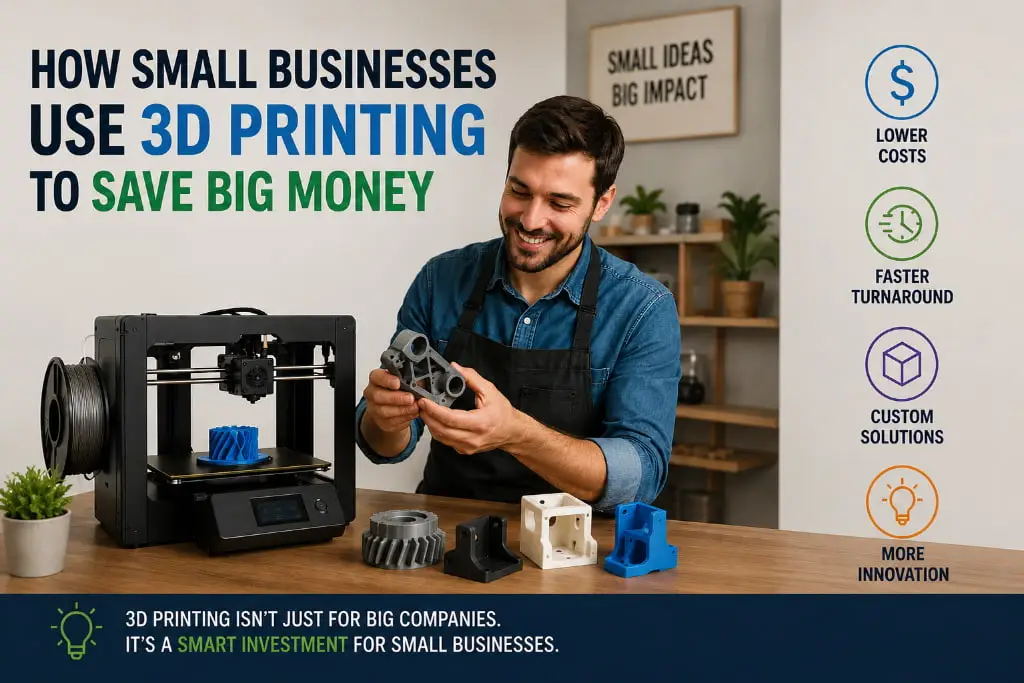
Running a small business means watching every rupee. Every decision about tools, equipment, parts, and products comes down to one question — is this worth the cost?
That is exactly why 3D printing has become one of the smartest investments small businesses are making right now. What was once an expensive technology used only by large manufacturers is now affordable, accessible, and incredibly practical for businesses of every size.
If you are a small business owner who has not yet explored what 3D printing can do for your bottom line, this blog will open your eyes to just how much money you could be saving.
The Real Cost Problem Small Businesses Face
Small businesses constantly deal with high costs — custom parts, product prototypes, marketing materials, tools, packaging, and more. Traditional manufacturing requires minimum order quantities, long lead times, and expensive tooling fees that simply do not make sense for a small operation.
You need five custom brackets for your workshop. A traditional manufacturer wants you to order 500. You need a prototype of your new product idea. An industrial design firm wants ₹50,000 just to get started.
This is where 3D printing changes everything.
1. Prototype Without Spending a Fortune
For any small business developing a new product, prototyping is the most expensive part of the process. Traditional prototyping involves hiring designers, paying for molds, and waiting weeks for samples — all before you even know if the product will work.
With 3D printing, you can produce a working prototype in hours for a fraction of the cost. Test the design, find the flaws, make changes, and print again — all within the same day.
A business that once spent ₹40,000 to ₹80,000 on a single prototype can now produce multiple iterations for under ₹2,000. That is money saved that goes directly back into growing the business.
Real impact: Faster prototyping means faster product launches — and faster revenue.
2. Eliminate Expensive Custom Part Orders
Every business has parts or components it needs in small quantities — custom brackets, fixtures, jigs, connectors, casings, or replacement parts for equipment. Ordering these from traditional suppliers usually means paying for large minimum quantities or expensive custom manufacturing fees.
With an in-house 3D printing setup, you print exactly what you need, when you need it. No minimum orders. No waiting two weeks for delivery. No paying for 200 parts when you only need 10.
For small manufacturers, repair shops, and product-based businesses, this single change can save tens of thousands of rupees every year.
3. Create Custom Marketing Materials and Displays
Product displays, signage holders, branded stands, custom packaging inserts — these are things every retail and product business needs. Ordering them custom from suppliers is expensive and slow.
3D printing lets you design and produce custom display stands, logo pieces, product holders, and presentation materials in-house. You get exactly what you want, in your brand colours, at a cost that is a tiny fraction of what a supplier would charge.
Small businesses using 3D printing for marketing displays report saving anywhere from 60 to 80 percent compared to ordering the same items from traditional manufacturers.
4. Reduce Dependency on Suppliers
Supply chain disruptions are a real problem for small businesses. When a key part goes out of stock or a supplier increases prices, it can stop your entire operation.
3D printing gives small businesses independence. Instead of relying entirely on external suppliers for critical components, you can print many of those parts yourself — on demand, in-house, at a consistent cost.
This is especially valuable for businesses that use specialized equipment or sell niche products where replacement parts are difficult or expensive to source. With a digital file saved on your computer, you can reprint any part at any time.
5. Offer Customization Without Extra Cost
Customization is one of the biggest competitive advantages a small business can offer over large companies. But traditionally, offering custom products means higher costs, longer production times, and more complexity.
3D printing flips this entirely. Changing a design to customize a product for a customer takes minutes — not days. You can offer personalized products, custom sizes, unique designs, and one-of-a-kind items without adding significant cost to your production process.
Businesses in gifting, home decor, architecture, healthcare, and retail are already using this advantage to win customers that larger competitors simply cannot serve with the same level of personalization.
6. Cut Training and Tooling Costs
Small manufacturing and repair businesses spend significant money on specialized tools and training materials. Jigs, fixtures, training aids, and custom tools are often expensive to source or commission.
With 3D printing, these items can be designed and produced in-house at minimal cost. A custom jig that would cost ₹5,000 from a machinist can be printed for under ₹200. Training models and visual aids that would cost thousands can be produced for a few hundred rupees.
Over a year, these small savings add up to a very significant number.
7. Low Startup Cost, High Return
The biggest concern most small business owners have about 3D printing is the upfront investment. But the reality is that a quality desktop 3D printer costs between ₹15,000 and ₹50,000 — a one-time investment that most businesses recover within the first few months of use.
Compare that to ongoing supplier costs, prototype fees, custom part orders, and display expenses — and the return on investment becomes very clear, very fast.
Filament costs are also extremely low. A 1 kg spool of quality PLA filament costs around ₹1,000 to ₹1,500 and can produce hundreds of small to medium-sized parts.
Small Business, Smart Business
3D printing is not just a technology — it is a business strategy. The businesses that adopt it early are the ones that move faster, spend less, and offer more than their competitors.
Whether you run a product company, a repair shop, a retail store, or a creative studio, there is almost certainly a way that 3D printing can reduce your costs and improve your operations.
The question is no longer whether small businesses can afford 3D printing. The real question is — can you afford not to use it?
3DReality — Helping Small Businesses Print Smarter
At 3DReality, we understand the challenges small businesses face every day. That is why we are committed to providing affordable, high-quality 3D printing services and expert guidance to help your business save money and grow faster.
From custom parts and prototypes to product development and filament supply, we offer complete 3D printing solutions designed specifically for businesses like yours.
Partner with 3DReality today — and start saving big with the power of 3D printing. Contact us now for a free consultation.
FAQ’s
Q1. Can a small business afford a 3D printer?
Yes — quality 3D printers start from ₹15,000 and pay for themselves within months of use.
Q2. How does 3D printing save money for small businesses?
It eliminates costly supplier orders, reduces prototype fees and lets you print exactly what you need.
Q3. What can a small business make with a 3D printer?
Custom parts, product prototypes, display stands, tools, packaging inserts and personalised products.
Q4. Is 3D printing practical for non-tech small businesses?
Absolutely — modern 3D printers are simple to use and perfect for any small business owner.
Q5. How much does filament cost for small business printing?
A 1 kg spool costs around ₹1,000 to ₹1,500 and can produce hundreds of small to medium parts.