3D printing has changed the way people design, create, and manufacture products. From prototypes and architectural models to medical devices and custom gifts, this technology is helping businesses and individuals turn ideas into reality faster than ever before. However, one of the most common questions beginners ask is, “What materials are used in 3D printing?”
The answer depends on what you want to create. Different materials offer different levels of strength, flexibility, durability, and finish. In this guide, we’ll explain the most common 3D printing materials in simple language so you can choose the right one for your next project.
Why Does Material Choice Matter?
The material you choose directly affects the strength, appearance, flexibility, and overall 3D print quality of your final product. A decorative model doesn’t need the same material as a functional machine part. That’s why selecting the right material is just as important as choosing the right printer.
Understanding these materials will help you make better decisions and achieve high-quality results.
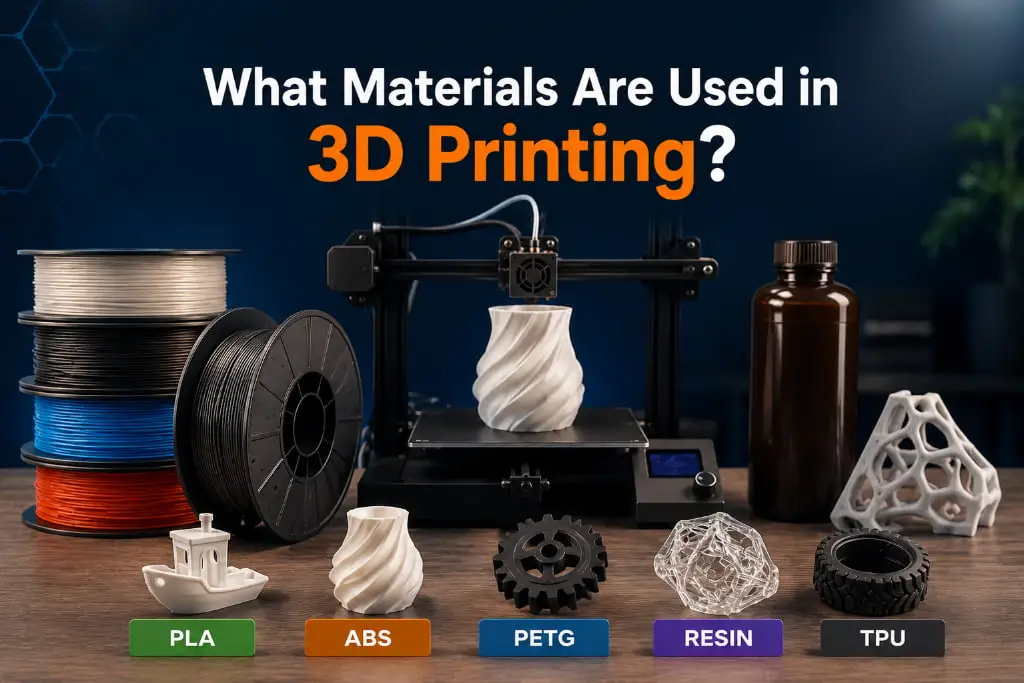
1. PLA (Polylactic Acid)
PLA is one of the most popular materials used in 3D printing, especially for beginners. It is made from renewable resources such as corn starch and sugarcane, making it more environmentally friendly than many other plastics.
Best for:
- Educational projects
- Decorative models
- Product prototypes
- Home décor
- Custom gifts
Advantages:
- Easy to print
- Smooth surface finish
- Minimal warping
- Available in many colors
If you’re starting your first printing project, PLA is usually the best choice because it offers excellent print quality with fewer printing challenges.
2. ABS (Acrylonitrile Butadiene Styrene)
ABS is a strong and durable plastic commonly used for products that need to withstand heat and impact.
Best for:
- Automotive parts
- Tool handles
- Functional prototypes
- Mechanical components
Advantages:
- High strength
- Heat resistant
- Long-lasting
- Easy to sand and paint
ABS requires higher printing temperatures and controlled cooling, making it slightly more advanced than PLA.
3. PETG (Polyethylene Terephthalate Glycol)
PETG combines the ease of PLA with the strength of ABS. It is becoming increasingly popular for both personal and commercial applications.
Best for:
- Food-safe containers
- Industrial parts
- Mechanical components
- Outdoor products
Advantages:
- Strong and durable
- Moisture resistant
- Good flexibility
- Excellent layer bonding
PETG is an excellent option when you need durability without sacrificing print quality.
4. TPU (Flexible Filament)
TPU is a flexible material that behaves more like rubber than plastic. It is perfect for products that need to bend or stretch.
Best for:
- Phone cases
- Shoe soles
- Protective covers
- Gaskets
- Wearable products
Advantages:
- Flexible
- Shock resistant
- Durable
- Long-lasting
Printing TPU requires slower speeds, but the final results are worth the extra time.
5. Resin
Unlike filament-based printers, resin printers use liquid resin that hardens under UV light. Resin printing produces extremely fine details and smooth finishes.
Best for:
- Jewelry
- Dental models
- Miniatures
- Medical applications
- Highly detailed prototypes
Advantages:
- Exceptional detail
- Smooth surface finish
- Professional appearance
Resin printing is ideal when visual quality and precision are top priorities.
What Are Filaments?
You may often hear the word filaments when discussing 3D printing. Filaments are long strands of material supplied on spools and used by FDM 3D printers. They are heated, melted, and deposited layer by layer to create an object.
Different filaments are designed for different applications, so choosing the right one can greatly improve the final result. High-quality filaments also help reduce printing failures and improve overall print consistency.
Don’t Forget About 3D File Design
Even the best material cannot produce great results if the digital model has design issues. A properly optimized 3D file design ensures your printer can accurately create the object without unnecessary errors.
Professional file preparation includes checking wall thickness, dimensions, supports, and print orientation. Good design practices not only improve print quality but also reduce material waste and printing time.
Choosing the Right Material
Before selecting a material, ask yourself a few simple questions:
- Will the product be decorative or functional?
- Does it need to handle heat or heavy use?
- Should it be flexible or rigid?
- Is appearance more important than strength?
- Will it be used indoors or outdoors?
Answering these questions will help you choose the most suitable material for your project.
Work with Experts for Better Results
Selecting the right material is only one part of a successful project. Experience, proper printer settings, and optimized designs all contribute to outstanding results.
At 3DReality, we are experts in 3D printing and custom 3D model development. Whether you need prototypes, engineering parts, architectural models, custom gifts, or industrial components, our team is here to help. We offer affordable printing service without compromising on quality, ensuring every project meets your expectations. Together, we can create custom 3D models, improve your designs, and bring your ideas to life with precision and care. Contact 3DReality today to discuss your next project.
Conclusion
Understanding the materials used in 3D printing is the first step toward creating successful projects. From beginner-friendly PLA to durable ABS, flexible TPU, strong PETG, and highly detailed resin, every material has its own purpose.
Choosing the right material, using quality filaments, and starting with a well-prepared 3D file design can significantly improve your results. Whether you’re creating a simple prototype or a complex product, working with professionals ensures you achieve excellent 3D print quality every time.
If you’re looking for reliable expertise and an affordable printing service, 3DReality is ready to help transform your ideas into high-quality 3D printed products.
FAQ’s
Q1. What is the most common material used in 3D Printing?
PLA is the most commonly used material because it's easy to print and beginner-friendly.
Q2. Which material is best for strong 3D printed parts?
ABS and PETG are excellent choices for durable and functional parts.
Q3. What are filaments in 3D Printing?
Filaments are plastic materials used by FDM 3D printers to build objects layer by layer.
Q4. Can I use different materials for different projects?
Yes, each material is designed for specific applications like prototypes, flexible parts, or detailed models.
Q5. Why is choosing the right material important?
The right material improves strength, durability, appearance, and overall print quality.