3D printing, once a niche technology, has rapidly evolved into a critical tool across various industries. As we look to the future, several key trends and innovations are poised to further revolutionize the field, driving new applications and possibilities.
1. Advanced Materials: Expanding Beyond Plastics
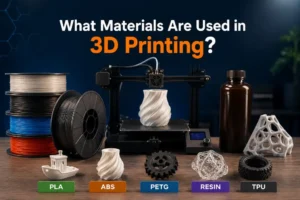
While traditional 3D printing has been dominated by plastics like PLA and ABS, the future lies in the diversification of materials. New developments in metal, ceramic, and composite materials are enabling the creation of parts that are not only durable but also suitable for demanding environments like aerospace and automotive industries. Additionally, bio-based and biodegradable materials are emerging as eco-friendly alternatives, pushing the boundaries of sustainable manufacturing.
- Metal 3D Printing: Techniques like Direct Metal Laser Sintering (DMLS) and Electron Beam Melting (EBM) are making it possible to create complex metal parts with high strength and precision, opening up new possibilities for industrial applications.
- Bioprinting: The use of biocompatible materials in 3D printing is paving the way for significant advancements in healthcare, including the potential for printing organs and tissues for medical use.
2. Speed and Scale: Making 3D Printing More Efficient
One of the primary challenges of 3D printing has been its relatively slow production speed compared to traditional manufacturing methods. However, innovations such as multi-material and multi-nozzle printers, as well as advancements in software optimization, are significantly reducing print times. Furthermore, large-scale 3D printers are now capable of producing bigger objects, from automotive parts to entire buildings, broadening the scope of 3D printing applications.
- Continuous Liquid Interface Production (CLIP): This technology uses light and oxygen to cure resins at unprecedented speeds, allowing for rapid production without sacrificing detail.
- Hybrid Manufacturing: Combining 3D printing with traditional manufacturing processes like CNC machining is enhancing both speed and accuracy, making it feasible for large-scale production.
3. Increased Accessibility: Bringing 3D Printing to the Masses
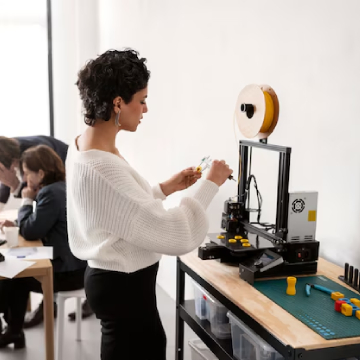
As the technology matures, 3D printing is becoming more accessible to both businesses and consumers. The cost of entry-level 3D printers continues to drop, while user-friendly software and online platforms are making it easier for non-experts to design and print their own objects. This democratization of 3D printing is expected to spur innovation and creativity across various fields, from education to small business.
- Cloud-Based 3D Printing: Platforms that allow users to design and print remotely are making it easier for people to access 3D printing services without owning a printer themselves.
- Consumer 3D Printing: Affordable desktop 3D printers are now widely available, enabling hobbyists and small businesses to experiment with additive manufacturing on a budget.
4. AI and Machine Learning: Enhancing Precision and Customization
The integration of artificial intelligence (AI) and machine learning into 3D printing is transforming the design and manufacturing process. AI algorithms can optimize designs for 3D printing, ensuring that objects are not only structurally sound but also resource-efficient. Additionally, machine learning is improving the accuracy and quality of prints by predicting and correcting errors in real-time.
- Generative Design: AI-driven design tools can create complex geometries optimized for specific performance criteria, which are then perfectly suited for 3D printing.
- Real-Time Monitoring: AI systems can monitor prints as they happen, identifying potential issues before they lead to failures, thus reducing waste and improving overall reliability.
5. Applications in New Industries: Expanding the Horizons
As 3D printing technology continues to evolve, it is finding applications in industries previously untouched by additive manufacturing. From fashion and food to construction and space exploration, the versatility of 3D printing is opening new doors.
- Construction: Large-scale 3D printers are being used to build houses and infrastructure quickly and cost-effectively, offering solutions for affordable housing and disaster relief.
- Space Exploration: NASA and other space agencies are exploring the use of 3D printing for creating tools and structures on other planets, using locally sourced materials like lunar or Martian soil.
6. Sustainability and Circular Economy: Reducing Environmental Impact
Sustainability is becoming a central concern in the world of manufacturing, and 3D printing is no exception. The technology’s ability to produce objects with minimal waste aligns with the principles of a circular economy. Additionally, efforts are being made to recycle and reuse 3D printing materials, further reducing the environmental impact.
- Closed-Loop Recycling: Some companies are developing systems to recycle old or failed 3D prints into new filament, creating a closed-loop system that reduces waste.
- On-Demand Manufacturing: 3D printing allows for the production of items on demand, reducing the need for large inventories and the associated environmental costs of storage and transportation.
Conclusion: A Bright Future Ahead
The future of 3D printing is incredibly promising, with advancements in materials, speed, accessibility, and applications poised to transform industries and daily life. As technology continues to evolve, it will not only enhance current capabilities but also unlock entirely new possibilities, making 3D printing a cornerstone of future innovation and sustainability. Whether you’re an industry professional or a curious enthusiast, staying abreast of these trends and innovations will ensure you’re ready to harness the full potential of this revolutionary technology.