The robotics industry is growing rapidly, with robots becoming an important part of manufacturing, healthcare, education, and automation. As companies look for faster and more efficient ways to develop robotic systems, 3D printing is emerging as a valuable technology. It allows engineers to create customized components, test new designs, and manufacture complex parts with greater flexibility.
Traditional manufacturing methods can require expensive tools, complicated processes, and longer production times. In comparison, 3D printing makes it easier to turn digital designs into physical components. From robotic arms to custom grippers, this technology is helping robotics companies develop innovative solutions while reducing development costs.
What Is 3D Printing in Robotics?
3D printing in robotics is the process of creating robot components layer by layer using digital 3D models. Engineers design parts using CAD software and send those designs to a 3D printer for production. Depending on the application, different materials such as PLA, ABS, PETG, Nylon, and carbon-fiber-reinforced polymers can be used.
This technology is not limited to robotics. It is also useful in developing customized medical devices, prosthetic components, and specialized equipment. Its ability to produce complex and application-specific designs makes it valuable across multiple industries.
How 3D Printing Is Transforming the Robotics Industry
3D printing is changing how robotic components are designed, developed, and manufactured. It gives engineers greater control over component shapes, sizes, and functionality.
Here are some important ways it is transforming robotics:
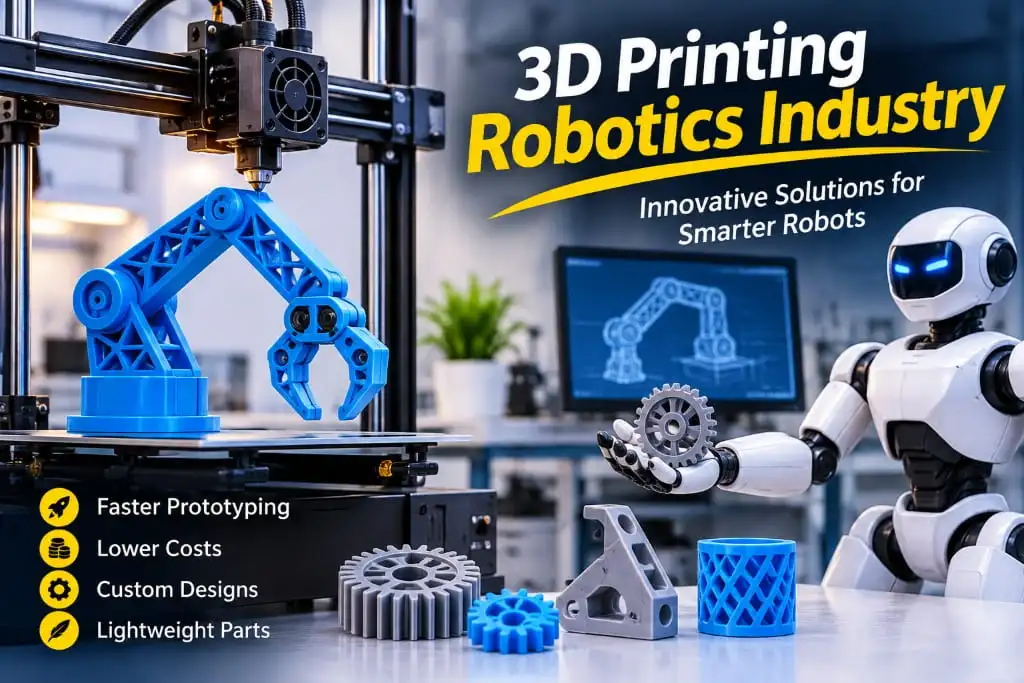
- Faster Prototyping: Engineers can quickly create physical prototypes and test their designs before final production.
- Lower Development Costs: 3D printing can reduce tooling requirements and material waste, making product development more affordable.
- Design Flexibility: Complex shapes and customized structures can be produced without complicated manufacturing processes.
- Lightweight Components: Engineers can create lightweight parts that help improve robot movement and efficiency.
- Easy Customization: Components can be modified according to specific robotic applications and requirements.
These advantages allow 3D printing engineers to experiment with innovative designs, improve component performance, and develop customized robotic solutions more efficiently.
3D printing is used in different areas of robotics, helping manufacturers and developers create specialized components.
1. 3D Printed Robotic Arms
Robotic arms require different joints, brackets, mounting structures, and supporting components. 3D printing allows engineers to manufacture customized parts that fit specific robotic designs and applications.
2. Custom Robotic Grippers
Grippers help robots pick, hold, and move objects. With 3D printing, developers can create custom gripping fingers and end-effectors for handling products with different shapes, sizes, and surfaces.
3. Humanoid Robots
Humanoid robots require carefully designed hands, fingers, joints, and body structures. 3D printing makes it easier to produce lightweight and detailed components for these robotic systems.
4. Industrial Automation
Manufacturing companies use customized robotic fixtures, brackets, protective covers, and mounting components to support automation processes. 3D printing helps produce these parts according to specific production requirements.
5. Educational Robotics
Schools, colleges, and research institutions can use 3D printing to develop affordable robot prototypes, experimental components, and learning models for robotics projects.
Best Materials for 3D Printed Robotic Components
Choosing the right material is important for creating durable and functional robotic parts. Different materials offer different levels of strength, flexibility, and resistance.
- PLA: Suitable for basic prototypes and educational robotics projects.
- ABS: Useful for durable enclosures and functional components.
- PETG: Offers a balance of strength and flexibility for brackets and housings.
- Nylon: Suitable for functional mechanical parts that require durability.
- TPU: Ideal for flexible components, protective covers, and soft robotic grippers.
- Carbon-Fiber-Reinforced Materials: Useful for lightweight components requiring additional stiffness.
The best material depends on the robot’s working environment, load requirements, temperature, and intended application.
3D Printing vs Traditional Manufacturing in Robotics
Traditional manufacturing is often suitable for producing large quantities of standardized components. However, it may require specialized tooling and additional setup for customized designs.
3D printing offers greater design flexibility and is particularly useful for prototyping, low-volume production, and customized robotic components. It can also reduce unnecessary material usage in suitable applications.
Both manufacturing methods have their advantages, and the right choice depends on production volume, material requirements, budget, and component complexity.
The Future of 3D Printing in the Robotics Industry
The future of robotics will involve more advanced automation, customized components, and innovative manufacturing technologies. 3D printing is expected to play an important role in developing lightweight robotic structures, flexible grippers, and complex mechanical components.
With improvements in printing technology and advanced materials, robotics developers will have more opportunities to create efficient and application-specific robotic systems. The combination of artificial intelligence, robotics, and 3D printing could also support faster innovation and smarter manufacturing processes.
Turn Your Ideas into Reality with 3DReality
At 3DReality, we specialize in professional 3D printing solutions that help transform creative ideas into accurate and functional physical models. Whether you need custom robotic components, engineering prototypes, or complex 3D designs, our team focuses on delivering quality, precision, and reliable results.
We help businesses, engineers, and innovators bring their concepts to life with advanced 3D printing technology. Connect with 3DReality and let’s turn your innovative ideas into reality!
FAQ’s
Q1. How is 3D printing used in the robotics industry?
It is used to manufacture robotic arms, grippers, joints, enclosures, prototypes, and customized mechanical components.
Q2. Can 3D printing create robotic arms?
Yes, 3D printing can produce robotic arm components such as brackets, joints, housings, and structural parts.
Q3. Which materials are best for 3D printed robot parts?
Nylon, ABS, PETG, TPU, and carbon-fiber-reinforced materials are commonly used, depending on the component's requirements.
Q4. How does 3D printing reduce robotics development costs?
It can reduce tooling expenses, material waste, and prototyping time, especially when producing customized or low-volume components.
Q5. Is 3D printing useful for robotics prototyping?
Yes, it allows engineers to quickly create, test, and modify physical models before moving towards final production.