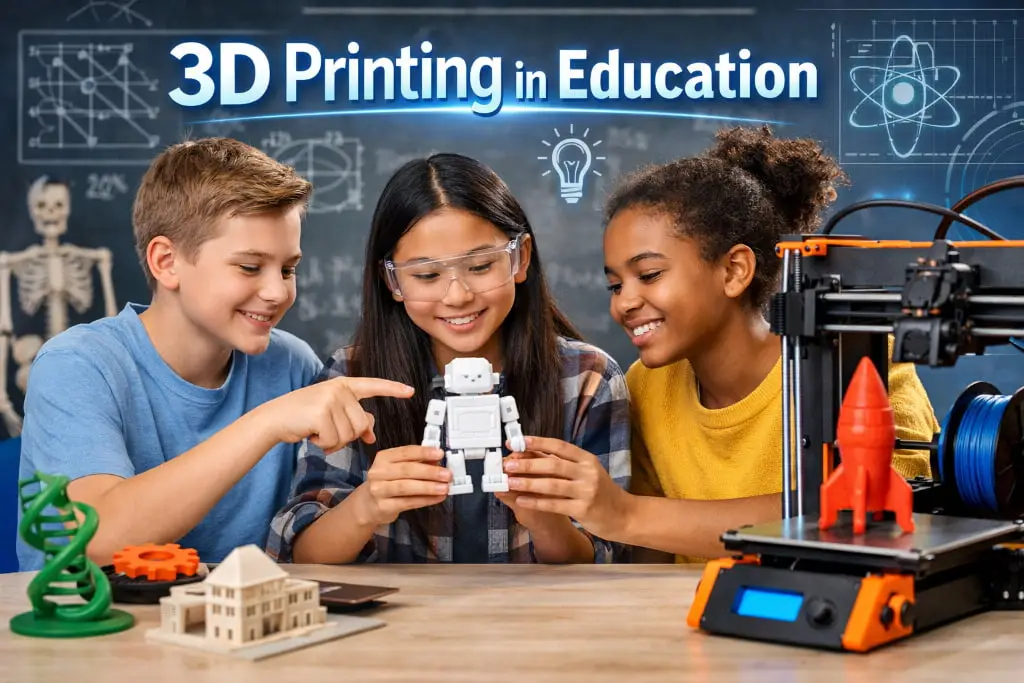
Technology is transforming the way students learn, and one of the most exciting innovations in modern education is 3D printing. Schools, colleges, and universities across the world are adopting 3D printing technology to create interactive learning environments that go far beyond traditional textbooks and lectures. By allowing students to design, prototype, and build real objects, 3D printing is preparing them with the practical skills needed for the future workforce.
In today’s fast-changing world, industries such as engineering, healthcare, architecture, and product design are rapidly integrating 3D printing into their processes. Introducing this technology in classrooms ensures that students are not only learning theoretical concepts but also gaining hands-on experience with cutting-edge tools.
What is 3D Printing in Education?
3D printing, also known as additive manufacturing, is a process of creating three-dimensional objects from digital designs by layering materials such as plastic, resin, or metal. In educational institutions, this technology enables students to transform their ideas into physical models.
For example, a student studying biology can print a 3D model of the human heart, while an engineering student can design and print machine components. This hands-on approach helps students understand complex subjects more effectively compared to traditional teaching methods.
Enhancing Creativity and Innovation
One of the biggest benefits of 3D printing in education is that it encourages creativity and innovation. Students are no longer limited to imagining ideas on paper—they can actually bring those ideas to life.
When students design their own models using 3D software and print them, they learn important skills such as:
- Creative thinking
- Problem-solving
- Design and prototyping
- Experimentation and iteration
This process builds confidence and motivates students to think like innovators and creators rather than passive learners.
Improving STEM Education
3D printing plays a crucial role in strengthening STEM education (Science, Technology, Engineering, and Mathematics). It allows teachers to explain complicated concepts through real-world examples and physical models.
For instance:
- Engineering students can print prototypes of machines or mechanical parts.
- Mathematics students can visualize geometric shapes in 3D form.
- Science students can study molecules, cells, or fossils through printed models.
This interactive learning experience helps students better understand complex theories and improves knowledge retention.
Developing Real-World Skills
Today’s employers value practical skills and hands-on experience. By learning 3D printing at an early stage, students develop technical abilities that are highly relevant in modern industries.
Students gain exposure to:
- Computer-aided design (CAD) software
- Product design and prototyping
- Manufacturing processes
- Engineering problem-solving
These skills prepare students for careers in industries such as manufacturing, robotics, aerospace, architecture, healthcare, and product development.
Making Learning More Engaging
Traditional classroom methods sometimes make learning feel repetitive or theoretical. 3D printing changes this by making education more interactive and engaging.
Students can participate in projects such as:
- Designing and printing small robots
- Creating architectural models of buildings
- Developing custom tools or gadgets
- Printing historical artifacts for history lessons
This project-based learning approach increases student engagement and encourages teamwork and collaboration.
Supporting Inclusive and Accessible Education
3D printing also helps make education more inclusive. Teachers can create customized learning materials that meet the needs of different students.
For example:
- Tactile models for visually impaired students
- Customized educational tools for special learning needs
- Interactive teaching aids for complex topics
This flexibility allows educators to create personalized learning experiences for every student.
Preparing Students for the Future Workforce
Industries around the world are rapidly adopting advanced technologies such as 3D printing, artificial intelligence, and robotics. By introducing students to these technologies early, educational institutions are helping them stay ahead in a competitive job market.
Students who learn 3D printing gain a strong foundation in innovation, design thinking, and digital manufacturing. These skills are essential for future careers in technology-driven industries.
The Future of 3D Printing in Education
The use of 3D printing in education is expected to grow significantly in the coming years. As the technology becomes more affordable and accessible, more schools and universities will integrate it into their curriculum.
Future classrooms may include dedicated makerspaces or innovation labs where students can design, build, and test their ideas using 3D printers and other advanced tools. This will create a new generation of problem-solvers, inventors, and entrepreneurs.
Conclusion
3D printing is revolutionizing the education sector by transforming how students learn and interact with technology. It encourages creativity, strengthens STEM education, and equips students with real-world skills that are essential for the future workforce.
By integrating 3D printing into classrooms, educators can create engaging and practical learning experiences that prepare students to thrive in a technology-driven world.
At 3DReality, we specialize in advanced 3D printing solutions, rapid prototyping, and custom 3D printing services for industries, businesses, and educational institutions. If you are looking to implement 3D printing technology for your projects or organization, our expert team is here to help bring your ideas to life.