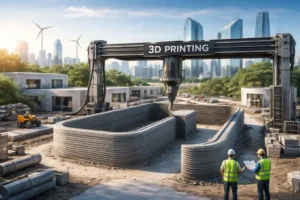
The global affordable housing crisis is no longer a distant problem—it’s happening right now. Rapid urbanization, rising construction costs, labor shortages, and limited land availability have made home ownership increasingly out of reach for millions. But what if the solution lies not in traditional bricks and mortar, but in 3D printing technology?
Over the past decade, 3D printing in construction has evolved from an experimental idea into a real-world solution. Today, governments, startups, and construction companies are exploring how 3D printed houses can reduce costs, speed up construction, and make housing more accessible. Let’s explore whether this revolutionary technology can truly solve the affordable housing crisis.
Understanding the Affordable Housing Problem
Affordable housing shortages are driven by multiple factors:
- High construction and material costs
- Long project timelines
- Skilled labor shortages
- Increasing population in urban areas
- Environmental regulations and sustainability concerns
Traditional construction methods are often slow, wasteful, and expensive. This is where 3D printing construction technology enters the conversation as a potential game-changer.
What Is 3D Printing in Construction?
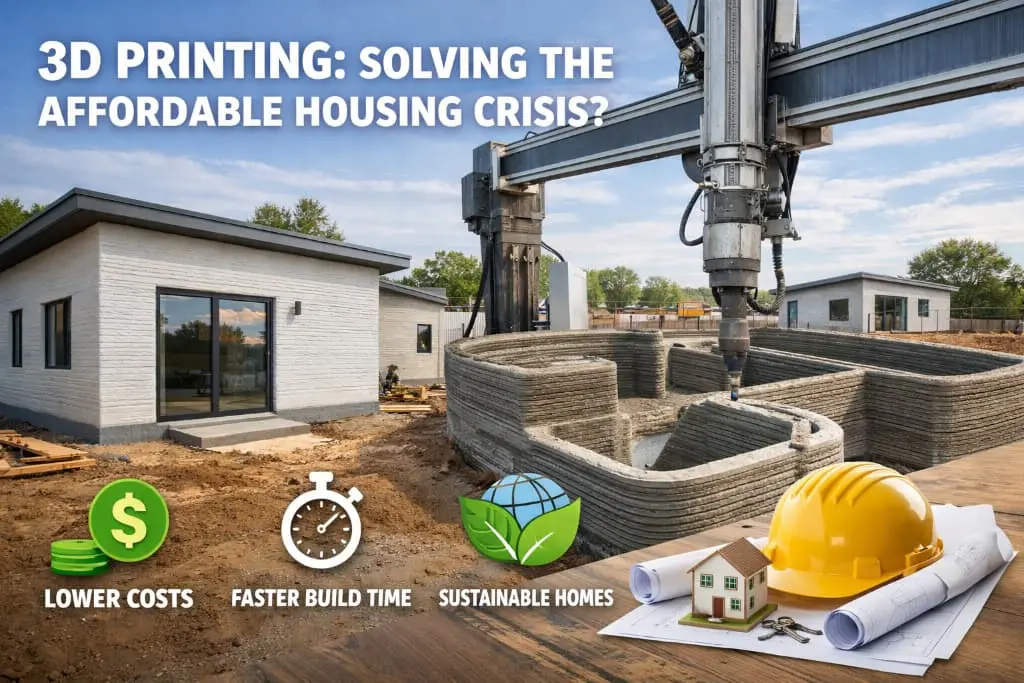
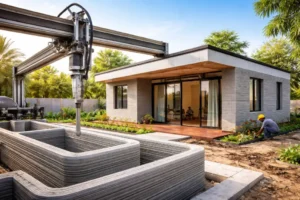
3D printing, also known as additive manufacturing, involves creating structures layer by layer using digital designs. In construction, large-scale 3D concrete printers are used to print walls, foundations, and even entire homes.
Using computer-aided designs (CAD), a printer precisely deposits construction material such as concrete or specialized composites. This automation drastically reduces human error, material waste, and construction time.
How 3D Printing Makes Housing More Affordable
1. Lower Construction Costs
One of the biggest advantages of 3D printed homes is cost reduction. Since machines handle most of the work, labor expenses drop significantly. Additionally, material usage is optimized, reducing waste and overall expenses.
2. Faster Build Time
Traditional homes can take months—or even years—to complete. In contrast, some 3D printed houses have been constructed in as little as 24–72 hours for the structural shell. Faster builds mean lower financing costs and quicker occupancy.
3. Reduced Material Waste
Construction waste is a massive environmental and financial issue. 3D printing technology uses only the required amount of material, making it both cost-effective and eco-friendly.
4. Design Flexibility
Complex architectural designs that are expensive with traditional methods become affordable with 3D printing construction. This allows developers to create functional, customized, and durable homes without extra cost.
Sustainability: A Hidden Advantage
Sustainability is a growing concern in modern construction. 3D printing in housing supports green building practices by:
- Minimizing waste
- Using eco-friendly materials
- Lowering carbon emissions
- Enabling energy-efficient designs
This makes 3D printed homes an excellent fit for sustainable and smart city projects.
Real-World Applications and Success Stories
Several countries have already implemented 3D printed affordable housing projects. From emergency shelters to low-cost residential communities, these projects demonstrate that the technology works—not just in theory, but in practice.
Governments are also showing interest because 3D printing construction aligns with goals like rapid urban development, disaster-relief housing, and infrastructure expansion.
Challenges That Still Exist
Despite its promise, 3D printing in construction faces a few challenges:
- High initial investment in 3D printers
- Limited building regulations and codes
- Material standardization issues
- Need for skilled operators and designers
However, as technology matures and adoption increases, these barriers are gradually being addressed.
Is 3D Printing the Ultimate Solution?
While 3D printing alone may not solve the affordable housing crisis overnight, it is undeniably a powerful part of the solution. When combined with supportive government policies, proper urban planning, and sustainable materials, 3D printing technology has the potential to reshape the housing industry.
It offers speed, affordability, sustainability, and scalability—four critical elements needed to tackle housing shortages worldwide.
The Future of Housing Is Being Printed
As innovation continues, 3D printed houses could become mainstream, especially in developing countries and high-demand urban regions. With lower costs and faster delivery, millions could gain access to safe and affordable homes.
3dreality welcomes you—we are expert in 3D printing industry. Contact us to explore how 3D printing can transform your construction and housing projects.
FAQ’s
1. Can 3D printing reduce housing costs?
Yes, 3D printing lowers labor, material waste, and construction time, making homes more affordable.
2. How long does it take to build a 3D printed house?
A 3D printed house structure can be completed in 24–72 hours.
3. Are 3D printed homes durable?
Yes, they are strong, weather-resistant, and designed to meet construction standards.
4. Is 3D printing eco-friendly for housing?
Yes, it reduces material waste and supports sustainable construction practices.
5. Is 3D printing suitable for affordable housing projects?
Yes, it is ideal for low-cost housing, mass housing, and rapid construction needs.